Retail personalisation with loyalty rewards
Exploring how rewards, personalisation and trust shape customer choice before checkout.
-
10 Competitors analysed
Comparative review of loyalty, retail and adjacent reward experiences to identify opportunities, risks and customer expectations.
-
4 CX principles
North star experience principles aligned stakeholders and guided prioritisation, design and delivery decisions.
-
4 Journey options
Redemption journey concepts were co-designed and evaluated against customer, business and technical requirements.
-
2 Usability test rounds
Prototype concepts were validated through iterative customer research to refine the MVP experience.
Problem Discovery
Telstra wanted to introduce loyalty rewards into digital retail journeys, including points redemption, personalisation and member authentication. The existing concept assumed rewards would primarily appear later in checkout. The risk was that rewards would become a transaction mechanic rather than a reason to choose Telstra.
The strategic question became: why would loyalty influence a customer if they only discovered its value after most of the purchase decision had already been made?
My role
I led comparative analysis, experience strategy, co-design activities, information architecture evaluation, journey design, prototyping and usability testing. I worked across product, design, technology, legal and service stakeholders to align customer needs with business and technical constraints.
Key Decisions
Define loyalty principles before designing screens
Rather than start with interfaces, I analysed competitor and adjacent rewards ecosystems and facilitated stakeholder workshops to establish four experience principles: influence the buying decision, maintain trust and the price promise, support strategic platform goals, and balance friction with functionality. The principles became a decision framework for evaluating every loyalty experience option.
Challenge when personalisation appears
The existing direction delayed meaningful loyalty value until checkout. I proposed exploring earlier personalisation and redemption visibility during product consideration, where loyalty could influence vendor choice rather than simply discount a purchase already underway. The trade-off was that earlier personalisation increased complexity because eligibility and account context were not yet known.
Evaluate four competing journey models
Working with stakeholders, I mapped and assessed four different approaches for where redemption should appear in the journey. Each option was evaluated against the agreed experience principles and the realities of platform constraints. The discussion shifted from opinions about screens to evidence-based trade-offs between influence, trust, feasibility and simplicity.
Use customer testing to challenge assumptions
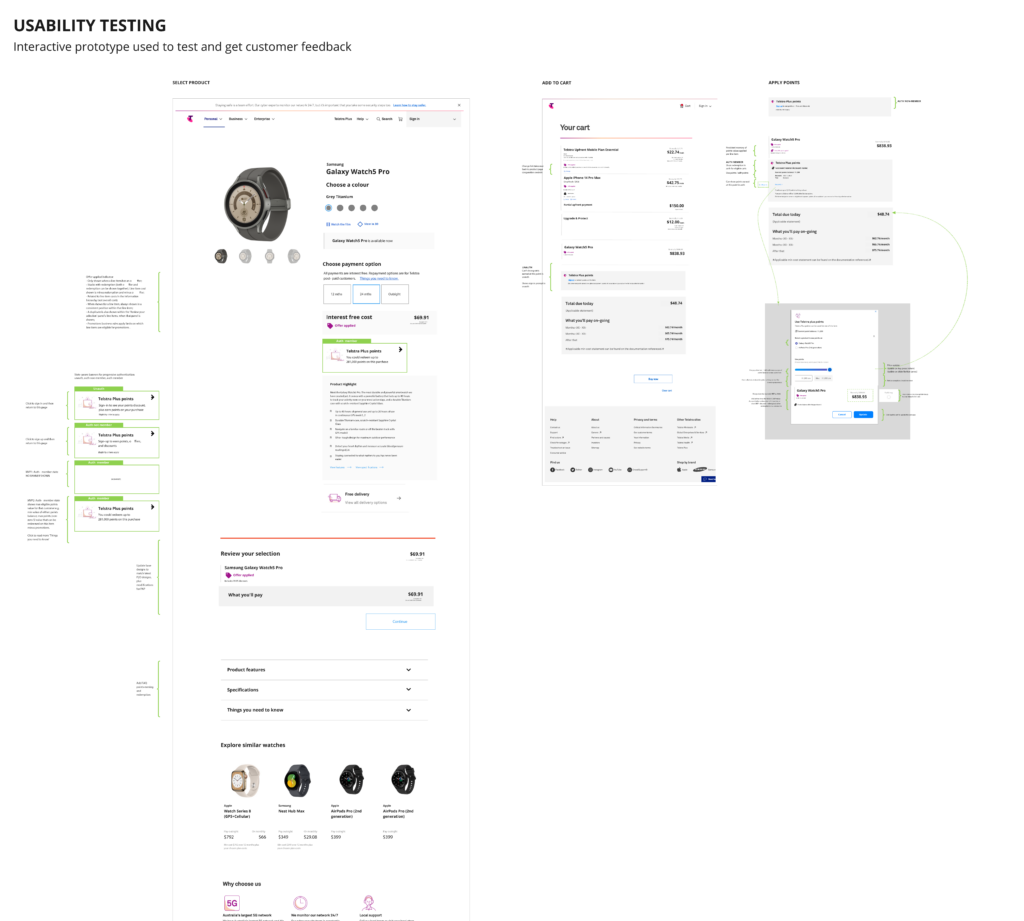
I created an interactive prototype and ran qualitative usability testing. Testing showed participants expected rewards redemption and points visibility much earlier in the experience. Expectations were shaped by other loyalty ecosystems and by customer assumptions about value transparency. Findings identified gaps between customer expectations and the MVP direction, creating evidence for further investment and iteration.
Insights & Outcomes
What testing revealed
- Customers expected rewards value to be visible during product exploration, not only at checkout
- Maintaining the price promise was critical to preserving trust
- Authentication and eligibility rules introduced hidden service complexity
- Points visibility, balance visibility and redemption clarity strongly influenced confidence
- Customers compared the experience against major rewards ecosystems they already used
What changed
- Created a shared set of loyalty experience principles used to prioritise design decisions
- Evaluated 12 rewards ecosystems and identified integration opportunities
- Aligned stakeholders around four strategic journey options
- Validated assumptions through prototype testing before implementation
- Identified priority UX debt and roadmap opportunities for future releases
- Provided evidence for future MVP iterations and broader loyalty integration
Reflection
The most important lesson was that loyalty is not primarily a checkout feature. Customers perceive loyalty as part of the value proposition. If rewards are hidden until late in the journey, much of their influence is lost.
If I approached this project again, I would test loyalty visibility concepts even earlier, before detailed solution design began. The research showed that customer expectations around rewards were stronger and more deeply learned than stakeholders initially assumed.